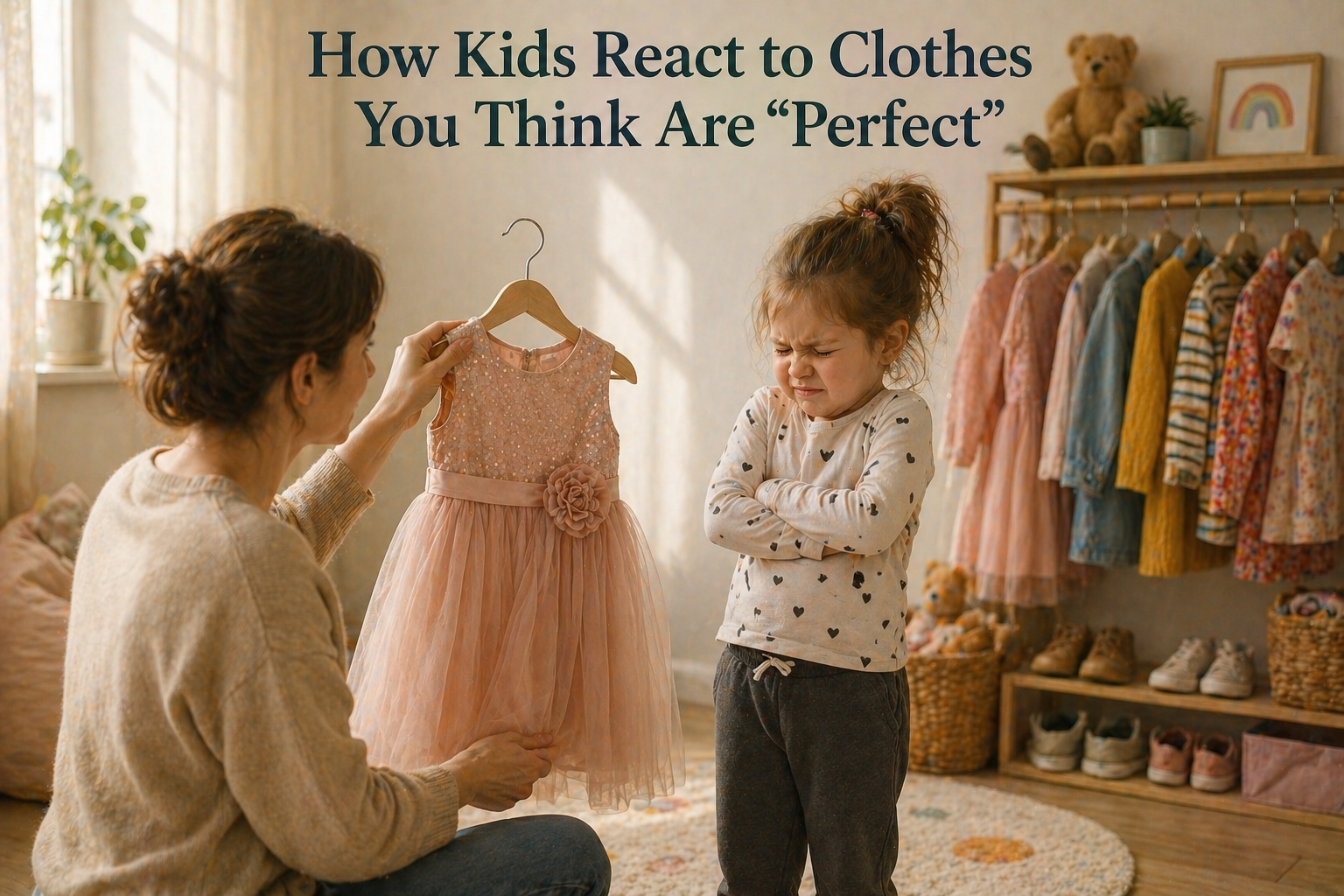

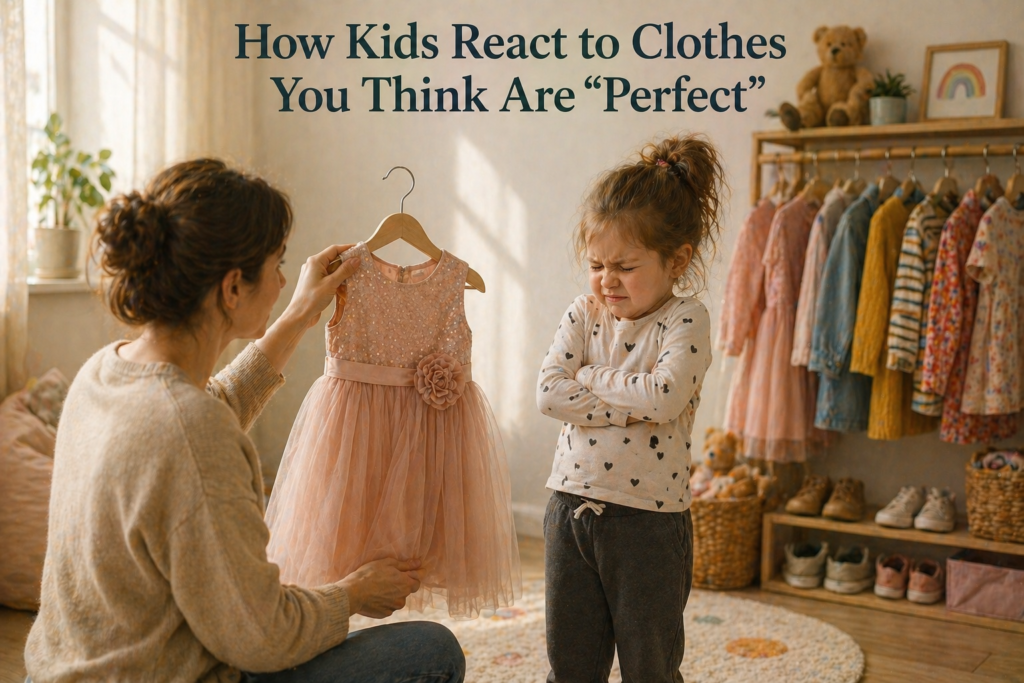
It’s a familiar moment: you pick something that looks ideal, and then everything stops. That’s usually when how kids react to clothes you think are “perfect” becomes clearer — not in theory, but in real time, right in the middle of getting dressed.
The Gap Between Expectation and Reality
From an adult perspective, the choice makes sense.
The size is right. The fabric feels soft. The outfit looks good together. There’s no obvious reason for it not to work. And yet, the reaction is immediate — hesitation, discomfort, sometimes a firm refusal.
What’s interesting is that this reaction rarely matches the visible qualities of the clothing. It’s not about whether something is objectively “good.” It’s about whether it aligns with how it feels in that moment.
That gap is where most confusion starts.
What Looks Right Isn’t Always Felt Right
There’s a quiet contrast here.
Clothes that appear perfect often follow certain standards: clean lines, balanced proportions, a certain neatness. But kids don’t experience clothes visually first — they experience them physically.
A well-shaped piece can still feel restrictive. A smooth fabric can still create irritation after movement. Even something lightweight can feel “wrong” if it sits differently than expected.
You might see structure. They feel pressure.
You see softness. They notice texture.
And because those sensations aren’t always easy to describe, the reaction comes out simply: “I don’t want this.”
When One Detail Changes Everything
Sometimes it’s not the whole outfit.
It’s one small element that shifts the entire experience. A seam that sits slightly differently. A neckline that feels tighter than usual. A sleeve that doesn’t fall the same way as before.
The difficulty is that these details don’t stand out visually. They only become noticeable through wearing.
A few common triggers tend to repeat:
- something that needs adjusting more than once
- a part that feels different after a few minutes of movement
- a sensation that wasn’t there the last time
Individually, they seem minor. Together, they redefine the piece completely.
And once that happens, the original “perfect” idea no longer matters.
The Role of Timing and Mood
Not every reaction is consistent.
The same clothing can be accepted one day and rejected the next. That inconsistency often looks unpredictable, but it usually isn’t random.
Energy, focus, and even the pace of the morning play a role. When everything moves quickly, tolerance for small discomfort drops. Things that might be ignored in a calm moment become noticeable under pressure.
So the reaction isn’t only about the clothing itself. It’s also about the situation in which it’s being worn.
That’s why understanding how kids react to clothes you think are “perfect” requires looking beyond the item — into the moment.
Familiar Pieces Win More Often
Over time, a pattern starts to form.
Children return to the same clothes again and again. Not necessarily the most stylish or new ones, but the ones that feel predictable. The ones that don’t introduce surprises.
Those pieces tend to share quiet qualities:
- they feel the same every time they’re worn
- they don’t need attention once they’re on
- they don’t interrupt movement or focus
Familiarity becomes a kind of comfort on its own.
And anything outside of that — even something objectively better — has to overcome that baseline.
When “Perfect” Isn’t the Point
What looks perfect from the outside often ignores the inside experience.
Clothing that works well for kids usually isn’t the one that checks every visual box. It’s the one that disappears once it’s worn — the one that doesn’t ask for attention, correction, or adjustment.
And once you start noticing how how kids react to clothes you think are “perfect” plays out in everyday situations, it becomes clear that the definition of “perfect” shifts.
It’s less about how something looks — and more about whether it lets the day continue without interruption.